श्रीमद् भगवद् गीता
All 700 verses, in language
anyone can follow.
The Bhagavad Gita is a conversation between a man who cannot get up and the friend driving his chariot. Every verse here comes with the original Sanskrit, a plain-English explanation, an example from a life you actually live, and the philosophy underneath.
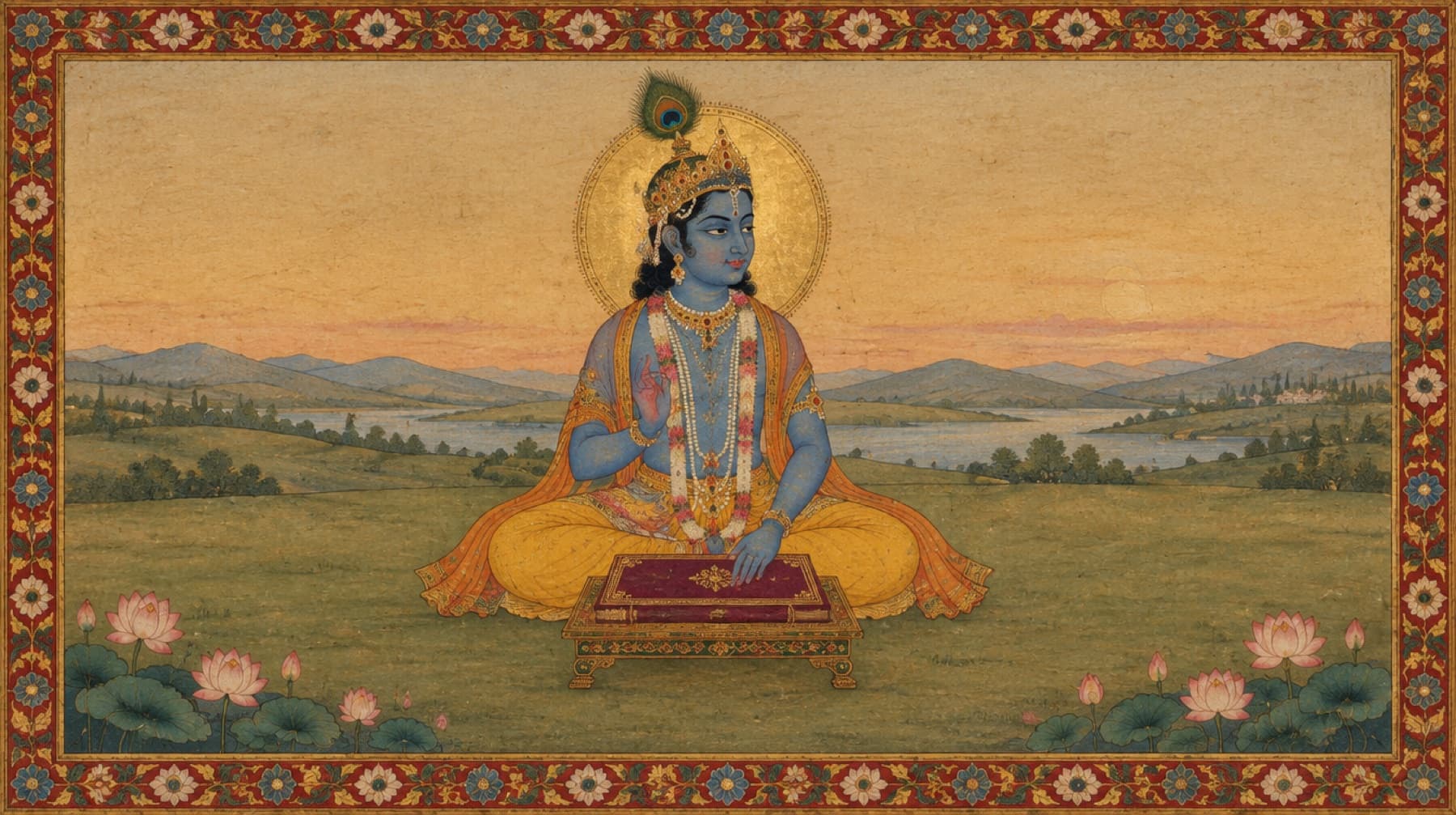
Chapter 2, Verse 47
कर्मण्येवाधिकारस्ते मा फलेषु कदाचन।मा कर्मफलहेतुर्भूर्मा ते सङ्गोऽस्त्वकर्मणि॥
karmaṇy-evādhikāras te mā phaleṣu kadācanamā karma-phala-hetur bhūr mā te saṅgo ’stvakarmaṇi
Your claim is on the action alone, never on its fruits. Do not let results be your motive. And do not let that become an excuse for doing nothing.
What you get for every verse
01
The original
The Sanskrit in Devanagari, with transliteration and a word-by-word breakdown you can open when you want it.
02
In plain words
What Krishna is actually doing in this verse, written for someone who has never opened the Gita before.
03
Where you've felt this
One concrete situation from ordinary life — work, family, illness, failure — that makes the idea land.
04
Going deeper
The philosophy: the term of art, the distinction being drawn, and how it connects to the rest of the book.
The eighteen chapters
All 700 verses of Sanskrit are already here. Commentary is being written chapter by chapter.
 01
01Arjuna Falls Apart
अर्जुनविषादयोगः
Two armies face each other. Arjuna asks his charioteer to drive him into the gap between them so he can see who he is about to fight. He looks, and he recognises everyone: his teachers, his cousins, the men who taught him to hold a bow. His body gives out. He puts down his weapon and sits down in the chariot.
47 of 47 explained
 02
02The Ground Under Everything
साङ्ख्ययोगः
Krishna begins to answer. He starts where Arjuna is stuck — on death — and argues that what is truly you was never born and cannot be killed. Then he turns from what is real to what to do about it, and lays down the idea the rest of the book is built on: do your work, and let go of your grip on how it turns out.
2 of 72 explained
 03
03The Path of Action
कर्मयोगः
If understanding is better than action, Arjuna asks, why push me into this terrible fight? Krishna answers that nobody gets to not act. Sitting still is also a choice with consequences. The question was never whether to act, only what you are acting for.
1 of 43 explained
 04
04Knowledge, Action, and Letting Go
ज्ञानकर्मसंन्यासयोगः
Krishna says this teaching is old, and that he has taught it before. Arjuna asks how that can be, since they are both alive now. The answer opens out into who Krishna is, and why the divine takes form when things go badly wrong.
1 of 42 explained
 05
05Giving Up, and Getting On With It
कर्मसंन्यासयोगः
Arjuna is still confused. Krishna keeps praising both giving things up and getting on with the work. Which is it? Krishna answers that they arrive at the same place, but one is easier to walk. You can hold everything lightly while your hands are still busy.
29 verses
 06
06Working With Your Own Mind
आत्मसंयमयोगः
The practical chapter. How to sit, how to eat, how to steady attention. Arjuna objects that the mind is as hard to hold as the wind. Krishna agrees — and says it can still be done, by practice and by loosening your grip.
1 of 47 explained
 07
07Knowing It, and Knowing It
ज्ञानविज्ञानयोगः
Krishna turns to his own nature — the whole world as his lower form, and something finer behind it. He describes the four kinds of people who turn toward the divine, including, plainly, those who come because they want something.
30 verses
 08
08What Does Not Perish
अक्षरब्रह्मयोगः
Arjuna asks a run of direct questions about what lasts, what dies, and what happens at the end. Krishna answers with the long view: vast cycles of time, and what the mind turns to in its final moment.
28 verses
 09
09The Open Secret
राजविद्याराजगुह्ययोगः
Krishna calls this the most direct teaching of all, and the most freely given. Everything rests in him without him being caught up in it. And the door is open to anyone at all — a leaf, a flower, water offered honestly is enough.
34 verses
 10
10Where You Can See It
विभूतियोगः
Arjuna asks where he should look to find the divine. Krishna answers with a long list: among mountains, the Himalaya; among rivers, the Ganges; among words, the single syllable. Wherever something is at its fullest, look there.
42 verses
 11
11Seeing the Whole Thing
विश्वरूपदर्शनयोगः
Arjuna asks to see it directly. He is given the eyes to do so, and what he sees is not comforting: every world and every being at once, and time itself devouring everything. He is terrified and begs for the familiar face back.
55 verses
 12
12The Path of Love
भक्तियोगः
After the terror of the vision, the shortest and gentlest chapter. Arjuna asks which is better: to love a form you can hold in mind, or the formless. Krishna says the road with a face on it is kinder, then describes what someone who has arrived is actually like to be around.
1 of 20 explained
 13
13The Field and the One Who Knows It
क्षेत्रक्षेत्रज्ञविभागयोगः
A clean distinction: your body and mind are a field, and there is something that knows the field. Krishna lists what real knowing looks like in a person — and almost all of it turns out to be character rather than cleverness.
35 verses
 14
14The Three Strands
गुणत्रयविभागयोगः
Everything in nature is woven from three strands: clarity, drive, and inertia. They bind even good people, and they take turns. Krishna describes how to recognise which one has hold of you right now, and what it looks like to no longer be pulled by any of them.
27 verses
 15
15The Highest Person
पुरुषोत्तमयोगः
An upside-down tree, roots in the sky and branches below, as an image of the world we live in. Krishna says to take an axe to it — not to the world, but to the attachment that keeps you hanging in its branches.
20 verses
 16
16Two Ways to Be a Person
दैवासुरसम्पद्विभागयोगः
Two sets of qualities are laid side by side. One opens a life out: fearlessness, honesty, patience, no appetite for cruelty. The other closes it down: self-display, anger, the certainty that you are owed. Krishna is blunt about where each leads.
24 verses
 17
17What You Put Your Faith In
श्रद्धात्रयविभागयोगः
Arjuna asks about people who are sincere but do things their own way. Krishna answers that faith takes the colour of the person holding it, then runs the three strands through everything: what you eat, what you give, what you do without being asked.
28 verses
 18
18Letting Go, and Being Free
मोक्षसंन्यासयोगः
The longest chapter gathers everything. What giving up really means, how the three strands shape knowledge and work and happiness, why doing your own work imperfectly beats performing someone else's. Then the final turn, and Krishna's last word — which is not an order, but a choice handed back.
1 of 78 explained